2026 Best Round Plastic Nursery Pot for Wholesale Buyers
Wholesale buyers evaluating a round plastic nursery pot in 2026 need more than a low unit price. Pot dimensions, rim strength, drainage, stacking, and consistent molding all affect daily nursery work. A pot that splits when handled can disrupt a full bench. Small details matter.
The U.S. Department of Agriculture’s 2023 Floriculture Crops report recorded $6.7 billion in wholesale sales from qualifying floriculture operations. That figure does not measure nursery-pot sales directly. It does show the scale of the growing sector that depends on reliable production supplies. For buyers, the practical question is whether a pot protects crop quality while keeping labor, storage, and freight manageable.
Horticultural economist Dr. Charlie Hall studies the business conditions shaping the green industry. A buyer-side paraphrase of the cost-focused perspective in his work is: “Judge a pot by the costs it creates across the entire growing cycle.” This is a paraphrase, not a verbatim quotation. That distinction matters; supplier claims deserve the same scrutiny as product specifications. Compare sample pots under real conditions: fill them, stack them, and check drainage after watering. Then review minimum order quantities, color consistency, and lead times. No single design suits every crop. Some buyers may also find that heavier pots increase freight costs more than expected. A careful comparison helps wholesale teams choose a round plastic nursery pot that fits their crops, workflow, and budget.
What Defines a Round Plastic Nursery Pot for Wholesale Use
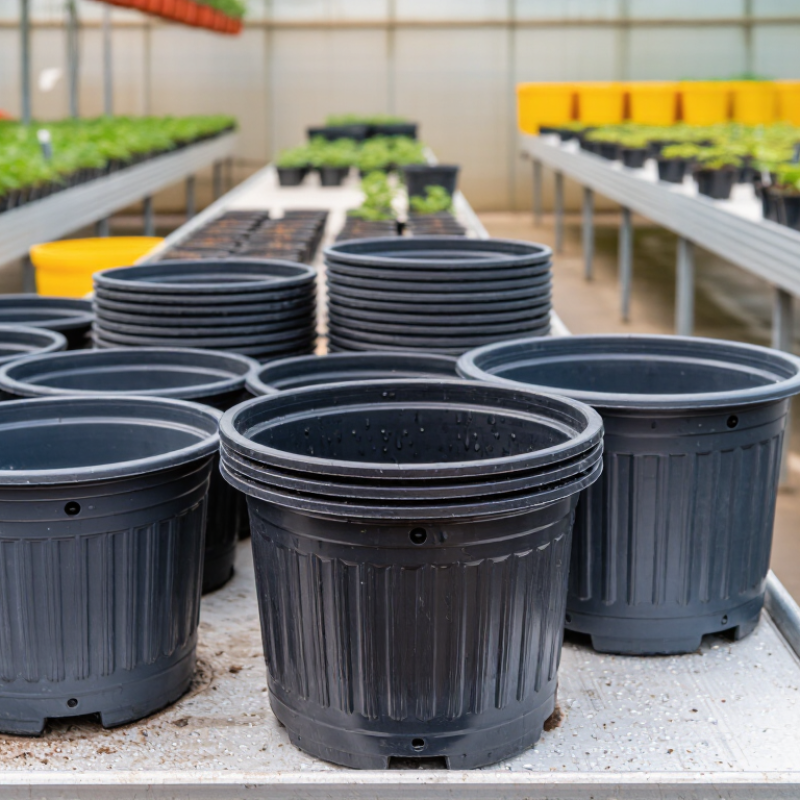
A round plastic nursery pot for wholesale use is a repeatable growing container, not simply a pot with a circular rim. Buyers need consistent top diameter, height, base size, and usable volume across each batch. These measurements affect how pots fit trays, benches, and packing lines. Small differences can create awkward gaps or make filled pots harder to handle.
Drainage matters in daily growing. Check the number and placement of drainage holes, then consider the crops and watering methods the pots will serve. Wall thickness also deserves attention: a pot should hold its shape when filled and moved, without adding unnecessary shipping weight. For warehouse handling, nested pots should separate without excessive force. Test a sample stack before ordering at scale. A product sheet helps, but hands-on checks catch details that measurements may miss.
Material and production consistency define reliability over repeated orders. Ask for specifications, sample units, and clear batch tolerances. If pots will sit outdoors, confirm that the material suits the expected exposure and service period. “Heavy duty” can mean different things. A thicker pot is not always the better choice if it raises freight costs or slows packing. Wholesale buyers sometimes focus on unit price and overlook handling time; that trade-off is easy to miss. The right pot depends on the crop, workflow, and shipping plan, and one standard size may not suit every operation.
2026 Best Round Plastic Nursery Pot for Wholesale Buyers - What Defines a Round Plastic Nursery Pot for Wholesale Use
| Nominal Pot Size | Approx. Top Diameter | Approx. Height | Approx. Capacity | Typical Wholesale Use | Practical Buying Check |
| 4 in | About 10 cm | About 9 cm | About 0.5 L | Seedlings, small herbs, and young ornamentals | Check that drainage holes are open and consistently formed. |
| 6 in | About 15 cm | About 13 cm | About 1.6 L | Established herbs, bedding plants, and starter perennials | Compare rim strength and sidewall flexibility for repeated handling. |
| 8 in | About 20 cm | About 18 cm | About 4 L | Small shrubs, larger perennials, and retail-ready patio plants | Confirm the base fits the trays and carts used at the growing site. |
| 10 in | About 25 cm | About 23 cm | About 8 L | Large ornamentals, shrubs, and landscape-ready stock | Check loaded-pot stability, stacking space, and shipping volume. |
Dimensions and capacities are approximate examples; actual measurements vary by pot design, wall taper, and manufacturer. For wholesale orders, confirm the usable internal dimensions, material, drainage pattern, stackability, and carton quantity before purchasing.
Materials and Design Features That Affect Pot Performance
For wholesale buyers, a round plastic nursery pot performs well when resin, wall shape, and drainage work together. USDA’s 2022 Census of Agriculture reported $18.3 billion in U.S. horticultural specialty crop sales, underscoring the scale of plant production and handling.
FAO’s 2021 report, Assessment of Agricultural Plastics and Their Sustainability, estimated 12.5 million tonnes of plastics were used in agricultural production worldwide, based on 2019 data. That figure covers many applications, not nursery pots alone.
The distinction matters.
Compare resin specifications, UV-stabilization claims, and recycled-content documentation. Ask suppliers for accelerated-weathering results, such as testing under ASTM G154, and for real-world exposure records.
A broad, reinforced rim can improve stacking and reduce deformation during transport, but a heavy rim alone does not guarantee durability. Small details matter. Drainage holes should release excess water without letting growing media spill during routine handling.
Black pots may absorb more solar heat, so color and wall thickness can affect root-zone conditions in exposed production areas. Check samples under your own watering and stacking routines; laboratory figures cannot capture every greenhouse or outdoor setup.
I would not choose by price per pot alone. When specifications are unclear, performance assumptions deserve another look.
How Pot Size, Drainage, and Shape Match Different Plants
2026 Best Round Plastic Nursery Pot for Wholesale Buyers
How Pot Size, Drainage, and Shape Match Different Plants
Pot choice starts with the root system, not the shelf. Shallow-rooted herbs and young annuals usually suit wider, modest-depth pots. Deep-rooted plants need more vertical room. A container that is too large can hold excess wet mix around a small root ball. Too small, and roots dry quickly on a warm delivery route. Check root depth and expected growing time before setting wholesale specifications.
Drainage holes matter, but hole count alone does not guarantee healthy roots. Match the openings to the growing medium, and keep them clear during packing. UMass Extension’s greenhouse guidance emphasizes managing both water retention and air space in container substrates. A practical check: after watering, the mix should drain freely without washing out. Not every crop behaves alike.
Shape affects spacing, stability, and handling. Tall pots can suit plants with deeper roots; broader bases help top-heavy foliage stay upright. For mixed orders, standardizing a few compatible sizes can simplify trays and shipping, though one shape will not fit every crop. The USDA National Agricultural Statistics Service reported $13.8 billion in U.S. horticultural sales in its 2019 Census of Horticultural Specialties, a reminder that small specification choices scale across large inventories. Measure filled pots, too; catalog dimensions can differ from usable interior space.
2026 Best Round Plastic Nursery Pots for Wholesale Buyers
Typical starting pot diameter ranges by plant group
These ranges are general starting points; choose a pot based on the plant’s root ball and growth stage. Round pots suit many common nursery crops. Ensure each pot has unobstructed drainage holes, and avoid sizing up excessively, as excess wet growing medium can increase the risk of root problems.
Wholesale Sourcing and Quality Checks for 2026
For 2026 wholesale sourcing, compare round nursery pots by usable volume, not rim diameter alone. A pot that looks standard may taper differently and hold less growing medium. Ask suppliers for a dimensional drawing, material specification, and sample from the production line. Small differences matter when trays, carts, and automated filling equipment must fit.
Demand is substantial, but it does not guarantee consistent pot quality. The USDA’s 2022 Census of Agriculture Horticulture Special Study reported $18.3 billion in U.S. horticultural sales. Plastics Europe’s Plastics—the Fast Facts 2024 estimated global plastics production at 413.8 million metric tonnes in 2023. These figures provide market context, not nursery-pot forecasts. Buyers should verify resin type, recycled-content claims, and batch consistency directly with suppliers.
Inspect samples under realistic conditions. Check rim rigidity, drainage-hole placement, wall thickness, and whether nested pots separate without sticking. Fill a sample pot with wet growing medium; then lift it by the rim and inspect for flexing or cracks. Ask for test methods and tolerances, not just a quality certificate. UV resistance also deserves attention for outdoor use. It can be easy to over-specify this, though, so match the test requirement to actual exposure and replacement cycles. Sample approval helps, but production batches can still vary.
