What Is Calcium Carbonate Stone?
Calcium Carbonate Stone is a broad term for natural stone made mainly of calcium carbonate, usually in the mineral form calcite. Some stones also contain aragonite. Limestone forms through processes such as the accumulation of shells and other marine material, while marble develops when limestone changes under heat and pressure. These names describe different geological histories, not identical products. Mineral content, texture, and strength can vary from one slab to another.
Look closely. A pale surface may show fine grains, fossil fragments, veins, or tiny pores. Those details affect both appearance and practical use. Calcium carbonate reacts with acids, so lemon juice, vinegar, and some cleaners can dull or etch an unprotected finish. This sensitivity is easy to overlook in kitchens and bathrooms. Sealing may reduce staining, but it does not make the stone acid-proof. Cleaning guidance should match the specific stone and finish, so supplier advice is worth checking.
This material appears in floors, wall cladding, counters, and decorative objects. Its suitability depends on porosity, finish, installation, and expected wear—not just its color or price. A sample can help reveal how light, water, and everyday handling affect the surface, though a small sample cannot show every variation in a full slab. There is no single performance rule for every calcium carbonate stone. Careful selection starts with understanding both its beauty and its limits.
Definition and Mineral Composition of Calcium Carbonate Stone
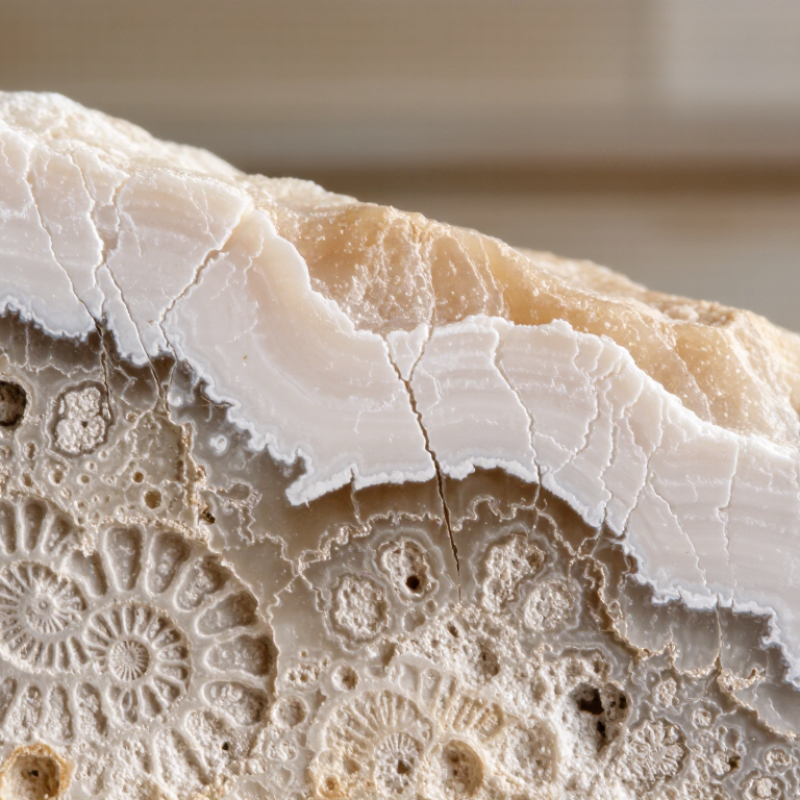
Calcium carbonate stone is a natural rock made mainly of calcium carbonate, with the chemical formula CaCO₃. Its principal mineral is calcite; some rocks contain aragonite, a less common form with the same chemistry. Pure CaCO₃ consists, by mass, of about 40% calcium, 12% carbon, and 48% oxygen. That is the ideal composition, not a promise about every quarry sample. Real stone may include clay, silica, iron-bearing minerals, or organic fragments. Look closely at a cut surface: shells, fine grains, and tiny pores can reveal how the rock formed.
Limestone is the most familiar calcium-carbonate stone, while marble forms when carbonate rock is altered by heat and pressure. Dolomite is related but contains magnesium as well as calcium, so it is not simply pure CaCO₃. The U.S. Geological Survey’s Mineral Commodity Summaries report tracks limestone and dolomite as major industrial minerals; its 2024 crushed-stone summary estimated U.S. production at roughly 1.5 billion metric tons in 2023. This large volume reflects uses ranging from construction aggregate to cement feedstock, not uniform stone quality. Composition varies between deposits, and even across one quarry face. A lab analysis matters when precise chemistry is required. The surface can mislead.
How Calcium Carbonate Stone Forms in Nature
What Is Calcium Carbonate Stone?
How Calcium Carbonate Stone Forms in Nature
Calcium carbonate stone forms through several natural processes, often over thousands to millions of years. In warm, shallow seas, tiny organisms build shells and skeletons from calcium carbonate. When they die, these fragments settle on the seabed and mix with sand or mud. More layers accumulate above them. Pressure gradually compacts the sediment, while minerals bind its grains together, creating limestone. The result may contain visible shell shapes, though some deposits become so fine-grained that their origins are hard to spot.
Water can also create calcium carbonate deposits without building a pile of shells. Rainwater absorbs carbon dioxide from air and soil, becoming mildly acidic as it moves through rock. It dissolves small amounts of limestone. Later, when the water loses carbon dioxide—perhaps in a cave or at a spring—calcium carbonate can precipitate again. Dripping water may leave thin mineral layers that grow into stalactites or stalagmites. Slowly, quietly.
These processes do not produce identical stone. Water chemistry, temperature, organisms, and sediment supply all influence its texture and structure. Travertine, for example, often forms around mineral springs, while many limestones began as marine sediment. A stone’s appearance can suggest how it formed, but appearances are not always enough; geologists may examine its minerals and layers to interpret its history. Even then, the record can be incomplete.
What Is Calcium Carbonate Stone? – How Calcium Carbonate Stone Forms in Nature
| Natural Material or Setting | How It Forms | Main Calcium Carbonate Source | Typical Features |
| Limestone | Calcium-carbonate-rich sediment accumulates, then becomes rock through burial, compaction, and cementation. Some limestone also forms when calcium carbonate precipitates directly from water. | Usually calcite (CaCO3), sometimes originally deposited as aragonite | A broad rock group with varied colors, grain sizes, fossils, and textures. |
| Fossil-rich limestone | Shells, skeletal fragments, and other remains of marine organisms collect on the seafloor and are gradually buried and lithified. | Calcite and aragonite in shells and skeletons | May contain visible fossils or shell fragments; common in ancient marine sedimentary sequences. |
| Chalk | Fine carbonate remains from microscopic marine organisms settle through the water and accumulate on the seafloor, later forming a soft, fine-grained limestone. | Mostly calcite from coccoliths, the tiny plates produced by certain marine algae | Typically white or pale, porous, and composed of very fine particles. |
| Reef limestone | Corals and other carbonate-producing organisms build frameworks in warm, shallow marine environments. Sediment and cement fill spaces in the framework over time. | Biological carbonate, mainly calcite and aragonite | Can preserve reef structures and contain abundant fossil material; often has irregular pores. |
| Oolitic limestone | Small grains form as calcium carbonate coats tiny particles in agitated, shallow water. The coated grains accumulate and become cemented together. | Usually calcite, formed in concentric coatings around grain nuclei | Recognizable by its small, rounded, egg-like grains called ooids. |
| Travertine | Calcium carbonate precipitates from mineral-rich groundwater or spring water, often as dissolved carbon dioxide escapes or water conditions change. | Calcite, with aragonite possible in some deposits | Often banded and porous; forms around springs, streams, and other carbonate-rich waters. |
| Cave deposits | Water carrying dissolved calcium and bicarbonate enters a cave. Carbon dioxide escapes from the water, allowing calcite to precipitate and gradually build mineral formations. | Calcite | Can form stalactites, stalagmites, and flowstone over long periods. |
| Marble | Limestone or dolostone is recrystallized by heat and pressure during metamorphism, changing its texture without necessarily changing its overall carbonate composition. | Calcite in marble derived from limestone; dolomite may be present in marble derived from dolostone | Typically has interlocking crystals and may show veins or color variations. |
In brief: Calcium carbonate stone is rock made mainly of carbonate minerals, especially calcite (CaCO3). It forms through biological accumulation, direct mineral precipitation, or the metamorphic recrystallization of older carbonate rock.
Physical and Chemical Properties
Calcium carbonate stone includes many limestones and marbles, but its properties vary with mineral content, grain size, and formation. Calcite is the most common mineral; some stones also contain aragonite or impurities such as clay and iron oxides. These differences affect color, texture, and performance.
Calcite has a Mohs hardness of about 3, so it can scratch more easily than quartz or granite. A steel knife may leave a mark on some polished surfaces, though results depend on the stone’s composition and finish. Porosity also varies: a dense marble may absorb little water, while a visibly porous limestone can take it in readily. Look closely. Tiny pores, fossil fragments, or fine mineral grains can be visible at the surface.
Chemically, calcium carbonate reacts with acids. Even weak acids can gradually etch a polished surface, and stronger acids release carbon dioxide as the mineral dissolves. That reaction helps explain why acidic rain can weather limestone buildings over time. Household cleaners are not all alike, so testing an inconspicuous spot is sensible. I would not assume two stones with similar colors will behave the same; appearance alone offers an incomplete guide. Surface treatment, moisture, and local mineral variation deserve attention.
Common Varieties and How to Identify Them
Calcium carbonate stone includes several materials that look different in a cut or weathered surface. Limestone commonly shows shells, grains, or compact layers; chalk is softer and often leaves a pale mark. Travertine has visible pores and bands formed around mineral-rich springs. Marble began as carbonate rock, then recrystallized under heat and pressure, giving it interlocking crystals. Some marbles contain other minerals, so appearance alone can mislead.
The USGS Mineral Commodity Summaries 2024 reports that limestone and dolomite account for about 70% of U.S. crushed-stone output. That scale explains why reliable field identification matters.
Look at a fresh, uncoated surface with a hand lens: calcite-rich stone may fizz under a drop of dilute acid. Carefully. Dolomite reacts more slowly unless scratched or powdered, while calcite has a Mohs hardness of 3 and can be scratched by a copper coin. Vinegar is safer but weaker, and coatings or weathering can hide the reaction. A field test is useful, not definitive; confirm uncertain samples with a qualified geologist or laboratory.
Uses, Maintenance, and Preservation
What Is Calcium Carbonate Stone?
Calcium carbonate stone includes materials such as limestone, marble, and travertine. Their textures and porosity differ, so care should match the specific stone. These materials appear in floors, counters, wall cladding, and decorative details. They bring natural variation, but they can also react to acids.
Wipe dust with a soft, dry cloth. For routine cleaning, use warm water and a stone-safe, pH-neutral cleaner. Blot spills promptly, especially wine, coffee, or citrus juice. Avoid vinegar, lemon cleaners, abrasive pads, and harsh powders; acids can dull or etch the surface. Small habits matter. A coaster may prevent a pale ring, but it cannot prevent every mark. Test first. Try any cleaner in an inconspicuous spot.
Some stones benefit from a penetrating sealer, depending on their absorption and finish. A sealer can slow staining, but it does not make stone stain-proof or acid-proof. Reapply only when the surface needs it, following the product instructions and testing a small area. Use felt under furniture, lift heavy objects rather than dragging them, and keep outdoor stone clear of standing water where freezing is possible. There is no perfect routine; local conditions and the stone’s finish matter. Even careful maintenance may leave small changes, and those can become part of the surface’s character.
