
How to Choose the Best Chocolate Wrapping Machinery?
Choosing the right Chocolate Wrapping Machinery begins with the product, not the machine’s advertised speed. A glossy praline and a chilled chocolate bar place different demands on film handling, sealing, and temperature control. Grand View Research estimated the global chocolate market at USD 119.39 billion in 2023. That scale makes reliable packaging more than a finishing touch: damaged wrappers can mean rework, waste, and lost shelf appeal.
Packaging educator Walter Soroka describes packaging as “the science, art, and technology of enclosing or protecting products for distribution, storage, sale, and use.” That principle matters on a chocolate line. A buyer should compare actual output at the required pack size, changeover time, wrapper compatibility, seal consistency, and ease of cleaning—not just the top speed on a brochure. Ask suppliers to demonstrate your product and film on the proposed machine. Watch the wrapper fold around corners. Check whether seals stay neat after handling.
Small details matter.
A machine that runs beautifully with one format may struggle after a recipe or wrapper change. I would not treat a showroom test as proof of long-term performance; production conditions are messier. The sections ahead explain how to weigh capacity, packaging style, automation, maintenance, and supplier support, so the chosen Chocolate Wrapping Machinery fits the line you actually operate.
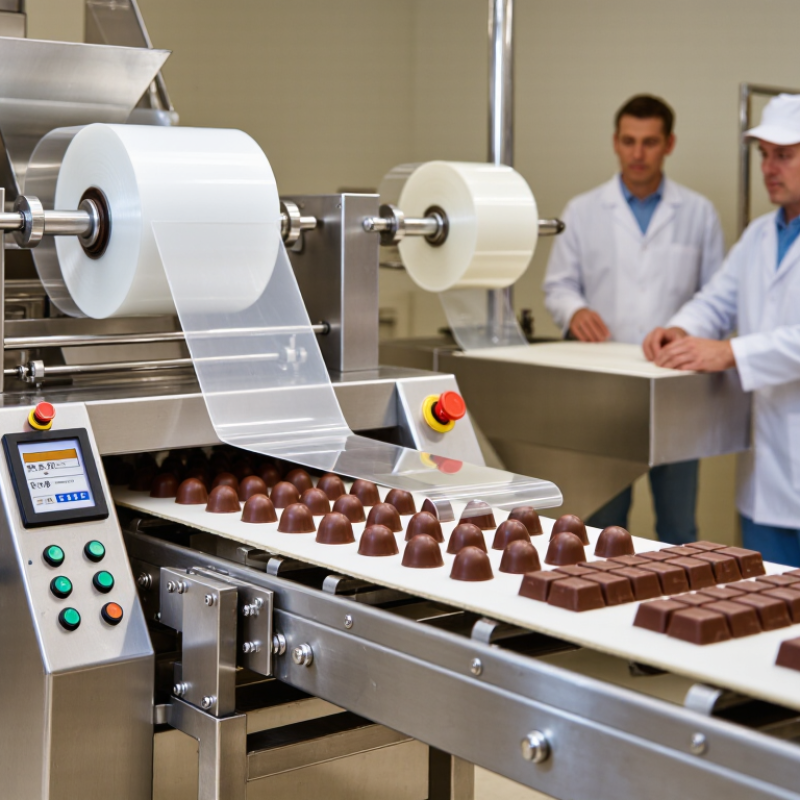
Define the Chocolate Product and Its Wrapping Requirements
Before comparing chocolate wrapping machines, define the exact product. A solid bar, filled praline, and irregular cluster behave differently on a conveyor. Record each item’s dimensions, weight, surface texture, and temperature at wrapping. A chilled chocolate may collect condensation; a soft filling can deform under pressure. Small details matter.
Next, specify the required wrap: foil, paper, film, or a layered structure. Note whether the package needs a tight seal, a folded end, or a clear window. These choices affect feeding, sealing temperature, and changeover time. The International Cocoa Organization’s 2023/24 estimates place global cocoa grindings near 4.8 million tonnes. That figure does not set your line speed, but it signals the scale of a category with varied product formats. For your own line, use measured demand and peak-season forecasts instead of a market-wide average.
Test representative samples, including the most fragile and the least uniform pieces. Check for cracked corners, loose folds, scuffed coatings, and seals that open after cooling. A specification can look complete on paper and still miss real production conditions. It happens. Leave room for adjustment, and document acceptable variation in product size and wrap tension before requesting machine quotations.
| Chocolate Product | Typical Product Form | Wrapping Requirements | Suitable Machine Configuration | Key Selection Checks |
|---|---|---|---|---|
| Chocolate bar | Rectangular bar, often with a solid, filled, or layered center | Close-fitting primary wrap that protects the surface and can provide a clean, consistent seal. Depending on the pack design, the bar may use a single flexible wrapper or a foil inner wrap with a paper outer wrap. | Flow wrapper for compatible flexible-film packs; folding or foil-wrapping equipment for formats that use folded inner or outer wraps. | Confirm bar dimensions, orientation, wrapper material, seal area, and whether the product needs one or two wrapping layers. |
| Chocolate tablet or block | Flat, broad piece, usually divided into molded sections | Wrap must accommodate the product’s width and thickness without damaging raised details or edges. Folded wraps may require accurate crease and tuck formation. | Folding-style wrapping machine or a flow wrapper designed for the tablet’s dimensions and chosen packaging material. | Check product rigidity, mold features, pack appearance, changeover needs, and whether the machine can control the product without excessive pressure. |
| Pralines and filled pieces | Individual molded pieces with varied shapes, fillings, or coatings | Gentle product handling is important because pieces may be delicate, irregular, or sensitive to heat. Each piece may need an individual wrap, a cup, a tray, or a combination pack. | Individual-piece wrapping equipment, or a feeding and placing system connected to tray or box packaging equipment. | Assess piece-to-piece variation, feeding method, product spacing, wrapper presentation, and how the system handles fragile or sticky surfaces. |
| Truffles and round confections | Round or near-round pieces, sometimes dusted or coated | Packaging should hold the piece securely and protect its coating. A cup, small formed wrap, or compartmented tray may be more suitable than a tight flat wrap. | Piece wrapping equipment with suitable product handling, or a placing system for cups, trays, and cartons. | Check that feeding and transfer do not rub off coatings, deform soft products, or cause pieces to roll or collide. |
| Twist-wrapped chocolate | Small individual piece with wrapper ends twisted around the product | The wrapper must be positioned consistently and allow the ends to twist securely without tearing or loosening. | Twist-wrapping machine matched to the piece shape, wrapper material, and required twist style. | Verify wrapper dimensions, material flexibility, product shape, twist consistency, and the ease of adjusting for different piece sizes. |
| Chocolate-coated wafer or bar | Long or rectangular product that may be brittle or prone to breakage | Product feeding and transfer should minimize impact. The pack should fit the product while maintaining a consistent seal and presentation. | Flow wrapper with a controlled infeed, suitable product guides, and a sealing setup compatible with the selected packaging material. | Check product fragility, infeed spacing, wrapper length, sealing temperature requirements, and the risk of crumbs affecting seals. |
| Assorted chocolates in a tray or box | Multiple pieces arranged in separate compartments or placed in a formed tray | Packaging must preserve the arrangement and prevent pieces from shifting. The tray or inner pack may need a film overwrap, lidding, or an outer carton. | Tray loading and sealing equipment, carton packaging equipment, or an integrated line combining loading, closing, and overwrapping. | Define the number and layout of pieces, tray dimensions, loading method, closure style, and the level of automation required. |
| Seasonal molded chocolate | Decorative, three-dimensional shape with a size and profile that may vary by design | Packaging should protect protruding details and avoid pressure that could crack or mark the chocolate. A fitted insert or carton may be needed for support. | Flexible wrapping equipment for compatible shapes, or a placing and carton-packing system with appropriately sized inserts. | Measure the maximum product profile, identify fragile projections, and test loading, clearance, and pack support with the actual product. |
| Multipack of individually wrapped pieces | Several bars, bites, or small packs grouped into one retail pack | Primary wrapping protects each piece; secondary packaging groups the pieces into a larger pack. Count accuracy and pack presentation are important. | Primary wrapping machine paired with a counting, collating, and secondary-packaging system such as a flow wrapper or cartoner. | Specify the number of units per pack, pack arrangement, required changeover range, and whether primary and secondary operations should be integrated. |