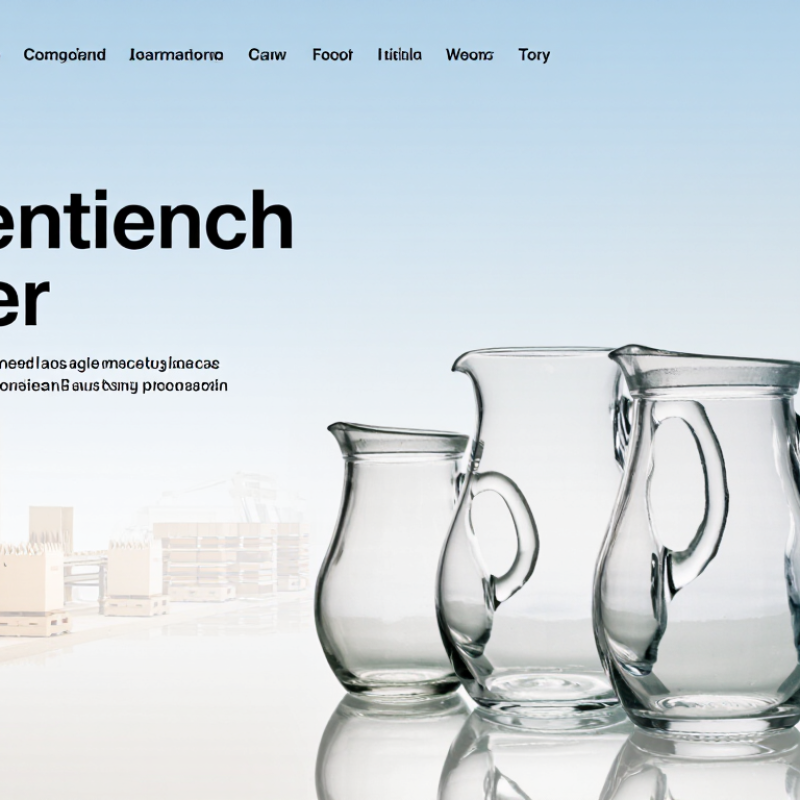
China Top Glass Pitcher Manufacturers for Global Buyers?

China has become a significant sourcing base for global Glass Pitcher buyers. Its manufacturers offer diverse designs, competitive production capacity, and flexible customization. However, choosing a supplier requires more than comparing catalog prices.

A reliable evaluation should examine glass composition, wall thickness, handle strength, lid fit, pouring control, and thermal performance. Buyers should also request food-contact documentation, factory audit records, sample approvals, and recent export references. A clear specification prevents expensive misunderstandings. It should define capacity, dimensions, tolerance, logo placement, packaging, and inspection standards.

“Glass is a material with memory, and every piece records its making.” — Lino Tagliapietra, internationally recognized glass artist

This observation matters for pitchers. Small forming differences can affect balance, clarity, and user safety. Experienced Chinese factories often combine automated forming lines with manual finishing. That combination can improve consistency, but it is not automatically reliable. Production scale can hide weak inspection practices.

Global buyers should compare manufacturers by total value, not only unit cost. Freight protection deserves close attention. A cracked pitcher can erase a seemingly attractive saving. Carton dividers, drop testing, and moisture-resistant packaging may deserve higher priority than decorative printing.

This guide examines China’s leading Glass Pitcher manufacturers through product quality, customization ability, certifications, production experience, and communication reliability. It also recognizes an uncomfortable reality: supplier rankings can change quickly. Factory ownership, equipment, export teams, and material sources may shift. Careful buyers should verify current evidence before placing large orders. Titles can guide research, but samples reveal the truth.

China Top Glass Pitcher Manufacturers for Global Buyers?

Glass Pitcher Manufacturing Landscape in China

China’s glass pitcher manufacturing landscape is broad, export-oriented, and highly segmented. UN Comtrade data for HS 7013, which includes household glassware, places China among the world’s leading exporters, with annual exports valued at roughly US$4 billion in recent years. Pitchers represent only part of this category, so the figure requires careful interpretation.

Production clusters commonly combine melting, forming, annealing, decoration, and packing. Large facilities often use automated pressing or blow-molding lines.

Smaller workshops may rely on skilled manual forming for textured or irregular designs. That flexibility helps buyers request custom handles, spouts, capacities, and packaging.

It can also create variation in wall thickness. The weak point is consistency.

According to Grand View Research, the global glass tableware market is expected to grow steadily through 2030, supported by hospitality demand and reusable household products. Chinese suppliers are responding with heat-resistant borosilicate glass, soda-lime glass, and recycled-content options.

Buyers should verify the exact material, not trust a product title alone. Factory audits should review batch records, annealing controls, rim smoothness, leakage tests, and carton drop results.

A 2023 report from the International Energy Agency also highlights the energy intensity of glass production, making furnace efficiency and recycled cullet increasingly relevant procurement factors. Some suppliers provide excellent samples but weaker mass production. That gap deserves scrutiny.

Key Types of Glass Pitchers Available for Global Buyers

Glass pitchers vary by material, shape, and intended use. Soda-lime glass remains common because it offers good clarity and economical production. Borosilicate glass handles temperature changes better, making it suitable for hot tea, chilled water, and refrigerator use. Tempered glass adds impact resistance, although it can still fail after severe thermal shock.

Common formats include straight-sided water pitchers, infusion pitchers with removable fruit filters, lidded juice pitchers, beer pitchers, and heat-resistant serving carafes. A 1.5–2 liter capacity suits family dining, while 2.5 liters or more serves restaurants and catering. Narrow spouts reduce dripping. Broad handles improve control when the vessel is full. Small details matter.

Fortune Business Insights reports that the global glass tableware market was valued at approximately USD 9.77 billion in 2023. Grand View Research also projects steady market growth through 2030, supported by hospitality and household demand. These figures suggest opportunity, but they do not guarantee product quality. Buyers should request thermal-shock tests, wall-thickness data, food-contact documentation, and lid-fit inspections. ISO 7086 testing can help evaluate glass hollowware safety and durability. I would not approve a supplier from one attractive sample alone. A pitcher may look flawless on a showroom table, yet its handle, spout, or lid may disappoint after repeated washing. Availability of replacement lids is worth checking, too.

Key Types of Glass Pitchers Available for Global Buyers

Representative nominal capacities commonly specified in international glassware catalogs. Actual capacity, shape, and features vary by supplier and product design.

Larger pitchers are generally suited to family dining, hospitality, and beverage service, while smaller formats are commonly used for individual tables, infused water, and refrigerator storage.

How China’s Glass Pitcher Manufacturers Handle Production

China’s glass pitcher manufacturers usually run a controlled, batch-based production line. Silica sand, soda ash, limestone, and recycled cullet are mixed before entering a furnace. The molten glass may exceed 1,500°C. Automated forming machines then shape pitchers inside metal molds, while annealing ovens slowly reduce internal stress. This step matters. A rushed cooling cycle can create invisible cracks around the handle.

UN Comtrade data shows China exported more than US$5 billion of HS 7013 glassware in 2023. This category includes tableware beyond pitchers, but it indicates strong manufacturing capacity. Experienced factories often combine automated inspection with manual checks. Inspectors examine rim smoothness, wall thickness, handle alignment, and thermal shock resistance. ISO 2859-1 sampling methods are commonly used for shipment inspections. However, quality can still vary between production batches. Buyers should not treat a factory audit as permanent proof of performance.

Tips: Request a pilot batch before mass production. Test filled pitchers for leakage, handle strength, and sudden temperature changes. Ask for the glass composition, tolerance range, carton drop-test results, and inspection records. A clear defect standard prevents arguments later. Also, check whether the factory controls mold maintenance internally. Worn molds may leave uneven seams or rough pouring edges. Small details become costly after thousands of units.

China Top Glass Pitcher Manufacturers for Global Buyers? - How China’s Glass Pitcher Manufacturers Handle Production
Production Dimension Typical Industry Practice Common Specification or Range How It Supports Global Buyers
Primary Glass Material Manufacturers commonly use soda-lime glass for standard pitchers and borosilicate glass for products requiring improved thermal-shock resistance. Soda-lime glass or borosilicate glass Buyers can select material according to price, appearance, temperature requirements, and intended market.
Manufacturing Methods Production may include glass blowing, pressing, molding, annealing, cutting, polishing, and manual or machine finishing. Molded, blown, or hybrid production Different methods allow suppliers to balance design complexity, consistency, tooling cost, and order volume.
Common Capacity Glass pitchers are generally produced in several household and food-service sizes to meet different retail and hospitality needs. Approximately 0.75–3.0 liters Multiple capacities make it easier to develop coordinated product ranges for supermarkets, online stores, restaurants, and hotels.
Wall Thickness Thickness is adjusted according to the glass type, pitcher shape, handle design, and expected usage conditions. Typically about 2.5–5.0 mm Appropriate thickness helps balance durability, product weight, thermal performance, and shipping cost.
Shape and Design Development Suppliers usually work from existing molds, technical drawings, samples, or buyer-provided 3D files. Stock designs, modified designs, or custom molds Buyers can reduce development time with standard designs or create differentiated products through custom tooling.
Handle Production Handles may be formed as part of the glass body or produced as separate components and attached during finishing. Integrated glass handle or separately attached handle Handle selection affects appearance, strength, production complexity, packaging, and final product cost.
Spout and Pouring Control Spouts are shaped through mold design and finishing processes to reduce dripping and improve pouring accuracy. Standard, wide-mouth, or drip-reduced spout profiles Functional spout design improves user experience and helps products meet the expectations of food-service and home-use customers.
Heat Treatment Annealing is used to relieve internal stress created during forming. Some products may receive additional thermal treatment where specified. Controlled annealing; optional heat-resistance requirements Proper thermal processing reduces the risk of stress-related breakage during handling and use.
Decoration Options Common decoration processes include screen printing, decal application, spraying, frosting, engraving, and color coating. Clear, frosted, printed, etched, or coated finishes Decoration enables market-specific designs without requiring a completely different glass-forming process.
Food-Contact Compliance Export-oriented manufacturers generally provide material and product documentation requested by the destination market. Documentation may include food-contact declarations, test reports, and material information Compliance files help importers prepare customs, retail, and marketplace documentation.
Quality Inspection Points Typical inspections cover dimensions, capacity, glass clarity, bubbles, stones, cracks, sharp edges, handle attachment, and decoration quality. Incoming, in-process, and final inspection Multi-stage inspection helps identify defects before packing and lowers the risk of claims after delivery.
Dimensional Tolerance Tolerance depends on the forming method, mold accuracy, product geometry, and buyer-approved specification. Often defined by approved samples and technical drawings Written tolerances provide a clearer basis for acceptance inspection than visual comparison alone.
Production Lead Time Lead time usually includes material preparation, molding or forming, finishing, inspection, and packing. Commonly about 30–60 days after sample and order confirmation Early approval of artwork, packaging, and specifications helps reduce schedule delays.
Custom Mold Development Custom projects require engineering review, mold design, trial production, sample approval, and final mold adjustment. Often several additional weeks beyond standard production Allowing time for mold trials helps buyers achieve stable dimensions and repeatable production results.
Order Quantity Planning Minimum order quantities vary according to whether the product uses an existing mold, a new mold, special colors, or custom decoration. Lower quantities for stock designs; higher quantities for custom projects Using an existing design can reduce tooling exposure and make market testing more practical.
Packaging Protection Individual protection commonly uses molded pulp, foam, paper separators, cartons, or combinations designed for fragile glassware. Individual pack, inner carton, and export master carton Packaging design is essential for reducing breakage during container loading, ocean transport, and warehouse handling.
Container Loading Loading quantity depends on pitcher capacity, packaging dimensions, carton configuration, and allowable stacking arrangement. Calculated by packed carton volume rather than product volume alone Accurate carton measurements help buyers estimate freight cost and landed cost before placing an order.
Sample Approval Export production commonly uses an approved pre-production sample or sealed reference sample for comparison. Visual, dimensional, functional, and packaging approval A signed reference sample reduces misunderstandings about color, size, surface finish, and decoration.
Traceability Organized production systems may link purchase orders with batch records, inspection records, packing lists, and shipment information. Batch-level or order-level records Traceability supports investigation, replenishment, quality claims, and repeat-order consistency.
Sustainability Considerations Glass is recyclable, while production efficiency can be improved through material control, cullet use where appropriate, and optimized packaging. Recyclable glass; reduced-plastic packaging options Environmental specifications can support retailer requirements and sustainability communication in global markets.

Quality Standards and Certifications for Export Markets

For global buyers, glass pitcher quality begins with controlled materials and repeatable production. Export-ready manufacturers should use food-contact glass with documented composition, thermal resistance, and surface safety. Each production batch needs traceable records, from raw materials to final inspection. Clear inspection photos help, but they are not enough.

Relevant certifications depend on the destination market. Buyers may request compliance with FDA food-contact requirements, EU Regulation (EC) No. 1935/2004, or Germany’s LFGB standards. ISO 9001 can support process control, although it does not prove product safety by itself. Independent laboratory testing should examine lead, cadmium, migration, thermal shock, and dishwasher durability. Packaging also matters. Dividers, drop testing, and moisture-resistant cartons reduce breakage during long transport. A certificate may be genuine but outdated. Verify its scope, testing date, and issuing laboratory.

Tips: Ask for a recent test report matching the exact pitcher model. Confirm whether lids, handles, coatings, and printed markings were tested too. Request a pre-shipment inspection with random carton sampling. Check lot codes against production records. Small gaps often appear there. It is also wise to review complaint procedures and replacement policies before ordering. Certification alone cannot guarantee flawless deliveries. Manufacturing changes, weak packaging, or rushed inspections can still create problems. Suppliers should explain these risks clearly, not hide behind paperwork.

How to Evaluate and Select a Reliable Chinese Supplier

Choosing among China’s top glass pitcher manufacturers requires more than comparing catalog prices. Start with the factory’s actual production capability. Ask whether it melts glass in-house or relies on outside workshops. Request recent photos of forming lines, annealing ovens, inspection tables, and packed cartons. A reliable supplier should explain glass type, capacity, wall thickness, heat resistance, and lid materials clearly.

Order samples before discussing large volumes. Measure the pitcher’s capacity and check the handle, spout, base, and lid fit. Pour water repeatedly. Watch for dripping, wobbling, sharp edges, or cloudy areas. One sample is not enough. Production consistency matters more than a perfect showroom piece.

Ask for a written quality standard, an inspection plan, and acceptable defect limits. Food-contact documents should be current and traceable to the supplied materials.

Communication reveals practical experience. Can the supplier answer technical questions without vague promises? Do they confirm drawings, packaging details, carton strength, and delivery dates in writing? Request references from comparable export projects, but verify them independently.

I once trusted attractive photos and overlooked weak inner packaging. Several pitchers arrived with chipped rims. That mistake changed my process. Now I check drop-test records, carton dividers, barcode accuracy, and replacement procedures before placing an order. A factory may be capable, yet still unsuitable for your market, order size, or inspection expectations.