50% Response rate
Choosing a gelatin factory supplier is not just a price comparison. Buyers need to assess origin, technical consistency, documentation, and the factory’s ability to deliver reliably. Small differences matter. A pale sample may look ideal, yet bloom strength, viscosity, odor, and dissolution behavior can affect a finished product.
Market reports offer useful context, but their estimates vary. Grand View Research estimated the global gelatin market at about USD 3.3 billion in 2023 and projected continued growth through 2030. These figures are estimates, not a purchasing forecast. They do show why global buyers face a wider supplier field—and why clear qualification criteria matter. A. Courts, co-author of The Science and Technology of Gelatin, documented how processing and raw-material characteristics shape gelatin properties. His work points to a practical lesson: ask suppliers for evidence, not assurances.
This guide to 2026 Top Gelatin Factory Suppliers for Global Buyers focuses on questions procurement teams can verify. Can the factory provide batch-specific certificates of analysis? Are traceability records and audit information available? Does its technical team explain specification changes clearly? A supplier’s sample should be tested under the buyer’s own application conditions. That step is easy to overlook. It can prevent costly surprises later.
The right Gelatin Factory Supplier will not necessarily be the largest or cheapest. It should be able to support the required grade, communicate realistic lead times, and document quality consistently. Supplier rankings are only a starting point. Buyers still need to check the details.
Gelatin is not a single interchangeable ingredient. Suppliers offer bovine, porcine, and fish gelatin in different forms and grades. Type A and Type B describe processing methods, not a simple quality ranking. Bloom strength measures gel firmness; viscosity, particle size, moisture, and microbiological limits also affect performance. Small differences matter. A gummy may need a firm, elastic bite, while a capsule line needs consistent flow and setting behavior. Hydrolyzed collagen is different: it dissolves readily but does not form the same gel.
Applications span confectionery, dairy desserts, meat products, and pharmaceutical capsule shells. Grand View Research estimated the global gelatin market at USD 3.2 billion in 2023 and projected 6.7% compound annual growth from 2024 to 2030. Its market analysis identifies food and beverage among the major application segments. For global buyers, that growth does not remove the need for careful qualification. Request a specification sheet, batch certificate, origin details, and sample results under intended processing conditions. A common gap in buying briefs is listing Bloom strength while omitting viscosity or the actual production temperature. Grades can look similar on paper, yet behave differently in a mixing tank. Test before scaling.
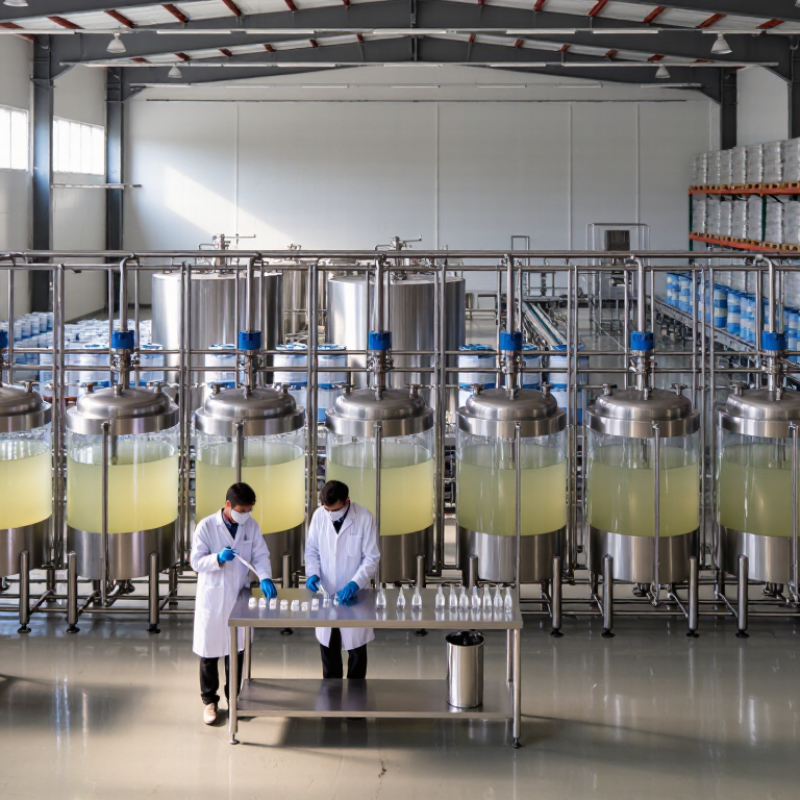
A gelatin factory’s work begins with collagen-rich raw materials, often sourced from inspected animal tissues. Incoming lots are checked for identity, condition, and records before processing. Cleaning removes visible residue, while controlled acid or alkaline treatment prepares the collagen. The exact method depends on the material and the desired product. Then warm water extracts gelatin in measured stages. Temperature and time affect the resulting strength and viscosity. Small details matter. Operators filter the liquid, concentrate it, and dry it into sheets or granules. A process description can sound cleaner than production really is; raw-material variation and equipment pauses still matter.
Testing continues throughout production. Technicians may measure gel strength, viscosity, moisture, pH, and particle size against agreed specifications. Microbiological checks and contaminant screening help assess product quality and suitability for its intended use. Gel strength is often reported as Bloom, but results depend on a defined preparation and test method. Samples need consistent handling. Batch records connect test results to processing conditions and raw-material lots, making later review more useful. Not every batch behaves identically. That variation deserves honest attention, rather than a claim that every sample performs exactly the same way.
When evaluating gelatin suppliers in 2026, begin with the product’s intended use and required specifications. Request a technical data sheet covering gel strength, viscosity, moisture, ash, and particle size. These figures help compare offers on equal terms. Small differences matter.
Ask how each batch is identified and what records accompany it. A reliable supplier should explain its testing process, retain relevant batch documentation, and describe how it handles deviations. Review quality certificates and audit information, but do not treat paperwork as a substitute for clear answers. Traceability must work in practice, not just on paper.
Assess supply capacity alongside product quality. Discuss typical lead times, minimum order quantities, packaging options, and plans for production interruptions. Then test a representative sample using your own process; performance in a supplier’s report may not match your equipment or recipe. Pay attention to how quickly questions are answered and whether responses are specific. There may be trade-offs: a lower price can come with longer lead times, while a detailed specification may still leave some practical questions open. Record those uncertainties before making a decision.
A practical, weighted framework for comparing gelatin manufacturers. Scores should be assigned using current documents, product samples, audits, and shipment records—not supplier claims alone.
| Evaluation criterion | Weight | What to verify | Evidence or buyer check | Strong evaluation signal |
|---|---|---|---|---|
| Food safety management | 15% | Whether the production site operates a documented food safety system with hazard analysis, controls, corrective actions, and regular review. | Current site-specific certificates, scope and expiry dates; audit summary; hazard analysis and critical control point documentation where applicable. | Valid certification to a recognized food safety scheme, such as FSSC 22000, BRCGS Food Safety, or another scheme accepted by the buyer, supported by satisfactory audit results. |
| Product specification and consistency | 15% | Ability to meet the buyer’s agreed requirements for bloom strength, viscosity, pH, moisture, ash, particle size, appearance, and solubility. | Approved specification, recent certificates of analysis (COAs), test methods, sample testing, and batch-to-batch results. | Each lot meets the buyer-approved limits, with clear test methods and a documented process for investigating out-of-specification results. Limits should be agreed for the intended application rather than assumed to be universal. |
| Traceability and recall readiness | 12% | Ability to trace raw materials and finished gelatin by lot, and to identify affected shipments during a withdrawal or recall. | Lot coding examples, mock-recall records, raw-material traceability procedure, and documented retention of production and dispatch records. | Traceability links incoming materials, production batches, COAs, packaging, and dispatch records; a documented recall procedure is tested periodically. |
| Raw-material sourcing and species control | 12% | Declared animal species and source, segregation controls, supplier approval, and suitability for the buyer’s religious, regulatory, or end-use requirements. | Species and origin declarations, supplier approval records, segregation procedures, and applicable halal or kosher certificates from recognized certifying bodies. | Source and species are transparently documented and consistent with the product specification; certification is verified for the relevant product and manufacturing site when required. |
| Regulatory and export documentation | 10% | Readiness to meet destination-market requirements and provide accurate product, safety, and shipment documentation. | Product and ingredient statements, safety data where applicable, certificates of analysis, certificates of origin, health certificates when required, and export documents requested by the destination authority. | Documents are complete, current, consistent with the product and shipment, and prepared for the buyer’s destination market. Requirements are checked country by country. |
| Microbiological and contaminant controls | 10% | Controls for relevant microbiological hazards and contaminants, based on product type, intended use, and applicable regulations. | Risk-based testing plan, recent laboratory results, sampling procedure, laboratory accreditation details where relevant, and corrective-action records. | Results meet applicable legal requirements and the buyer’s agreed specification; testing frequency and methods are documented and risk-based. |
| Manufacturing capacity and continuity | 8% | Available capacity, production scheduling, maintenance, backup arrangements, and ability to manage demand changes. | Capacity statement, typical lead times, planned shutdown calendar, business continuity plan, and performance history for comparable orders. | Capacity and lead times are clearly stated, order commitments are supported by production planning, and continuity risks have documented mitigation plans. |
| Packaging, storage, and shelf life | 7% | Packaging integrity, food-contact suitability where required, protection from moisture, storage instructions, and shelf-life support. | Packaging specification, storage and handling guidance, shelf-life evidence, and inspection records for packaging materials and finished goods. | Packaging is appropriate for the product and transport route, with clear lot identification and storage conditions supported by product documentation. |
| Quality communication and corrective action | 6% | Responsiveness to technical questions, complaint handling, change notification, and investigation of quality issues. | Documented complaint procedure, sample investigation reports, change-control process, and agreed response times. | Issues are investigated systematically, root causes and corrective actions are documented, and buyers are notified of relevant specification or process changes. |
| Commercial and logistics reliability | 5% | Clarity of quotations, order terms, shipment planning, and ability to provide consistent delivery updates. | Written quotation, agreed Incoterms® rule and named place, payment terms, shipment records, and packaging or pallet details. | Terms are transparent, delivery commitments are realistic, and shipment documents align with the purchase order and destination requirements. |
| Maximum weighted score | 100% | Score each criterion from 1 to 5, where 1 = insufficient evidence or major gaps and 5 = strong, verified performance. Weighted result = criterion score ÷ 5 × criterion weight. | ||
Use the same specifications and scoring method for every candidate. Certification, testing, labeling, and import requirements vary by product and destination market; confirm current requirements with the relevant authorities and the buyer’s quality team.
Leading gelatin factory suppliers differ in more than production scale. Their profiles should explain raw material sourcing, extraction methods, quality controls, and available product grades. Some serve food manufacturers, while others focus on pharmaceutical or technical applications. A clear profile describes its capabilities without treating every grade as interchangeable. Small details matter.
Suppliers across Asia, Europe, and the Americas may offer different strengths, but location alone says little about reliability. Look for documented testing, batch traceability, and staff who can explain viscosity, gel strength, and handling requirements. Facility descriptions are useful, yet they do not replace current specifications or a direct review of sample documents. Some polished profiles leave gaps. A supplier may publish broad claims without showing how results are checked for each batch.
Tips: Compare technical data sheets using the same criteria, and ask how the factory manages specification changes. Request recent test results and clarify packaging, lead times, and sample availability. Check that certificates match the product and facility being discussed. Then verify key details directly; online profiles can become outdated.
An industry-wide view of the raw materials used in gelatin production—not a comparison of individual suppliers.
Pigskin is the largest source in this commonly cited industry estimate. Actual sourcing shares vary by region and market; figures are approximate.
Global buyers comparing gelatin suppliers should start with the intended application, not a sales brochure. Food, pharmaceutical, and technical uses can require different grades and performance ranges. Check gel strength, viscosity, moisture, and microbiological data against your own product specifications. Small details matter. A clear specification makes supplier quotations easier to compare.
Request a recent certificate of analysis, traceability information, and an explanation of how each batch is tested. Then evaluate samples under your actual processing conditions. Samples can mislead. A small trial may not reveal variation across multiple production lots, so discuss batch consistency and corrective actions with the supplier’s quality team. Ask practical questions about packaging, storage, lead times, and how production changes are communicated.
Price matters, but landed cost also reflects freight, minimum order quantities, and the risk of delayed supply. Review sample records and technical responses carefully, and arrange a facility assessment when the order size justifies it. A spreadsheet helps, but it can hide weak assumptions; for example, estimated delivery times may not match peak-season conditions. Keep a written comparison of verified facts, open questions, and trade-offs before committing to a sourcing plan.